The Hallucination Trap: Why ChatGPT Fails at Literature Reviews
Every semester, undergraduate and graduate students make the same fatal academic mistake: they open ChatGPT or Claude and paste: "Write me a literature review on the impact of microplastics on cognitive function with 10 peer-reviewed references."
The result is a beautifully written, academically styled disaster. Large Language Models are probabilistic next-token predictors. When asked for obscure scholarly papers, they routinely invent plausible-sounding titles, non-existent journal volumes, and fabricated Digital Object Identifiers (DOIs). Submitting these hallucinated citations is an instant academic integrity violation.
To automate a literature review ethically and effectively, you must invert the workflow: AI must never generate citations out of thin air; it must only analyze real, retrieved, peer-reviewed PDFs.
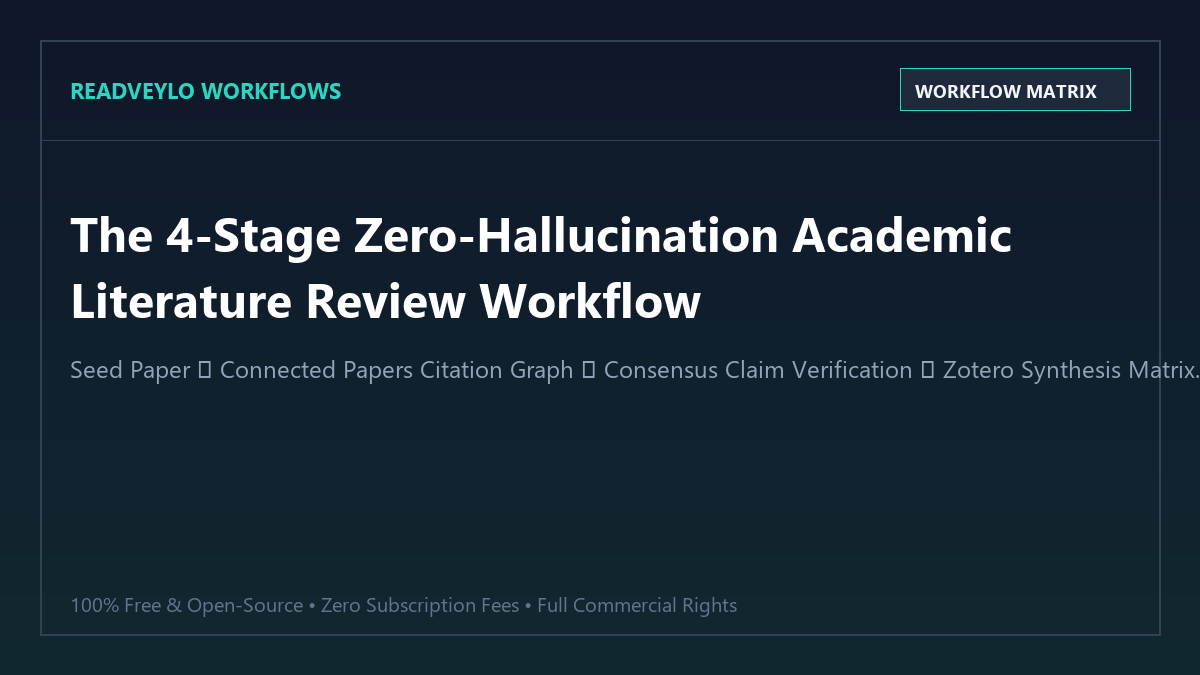
The 4-Stage Zero-Hallucination Research Architecture
Here is the proven, systematic pipeline used by top researchers to digest 50+ papers in a single weekend:
Stage 1: Citation Graph Mapping with Connected Papers
Traditional research begins with keyword searches on Google Scholar, which leaves you trapped in a filter bubble of top-cited legacy papers. Instead, start with one high-quality "Seed Paper" from your syllabus or reading list.
- Paste the seed paper DOI into Connected Papers (or ResearchRabbit).
- The tool constructs a visual co-citation graph based on shared bibliographies and co-citations, rather than simple keyword matching.
- Identify the Prior Works button to locate foundational papers that shaped the field.
- Click Derivative Works to find recent publications that built directly upon the seed paper's findings.
- Export the top 20–30 paper DOIs directly into your Zotero reference library in one click via
.bibexport.
Stage 2: Scientific Consensus Analysis with Consensus.app
Before reading 30-page methodologies, you need to understand where the scientific community currently stands on contentious research questions.
Use Consensus.app (which indexes over 200 million peer-reviewed papers):
- Search empirical research queries like: "Does intermittent fasting improve insulin sensitivity in healthy adults?"
- Review the Consensus Meter: Consensus analyzes the abstracts of dozens of clinical trials and categorizes them into Yes (75%), Neutral (15%), or No (10%).
- Identify the study methodology tags: Filter exclusively for Randomized Controlled Trials (RCTs) or Systematic Meta-Analyses to eliminate weak observational noise.
Stage 3: Deep Evidence Extraction with Zotero & NotebookLM
Once you have curated 15–25 high-impact papers in Zotero, download their full-text PDFs. Now you deploy source-grounded Retrieval-Augmented Generation (RAG):
- Create a new notebook in Google NotebookLM (or host an offline private vault using AnythingLLM + Ollama).
- Upload all 15–25 full-text PDFs into the notebook as distinct source files.
- Because NotebookLM is strictly grounded in your uploaded documents, every claim it synthesizes contains an interactive citation pill linking directly to the exact page and paragraph in the original PDF.
Stage 4: Building the Comparative Literature Matrix
The core of a master’s thesis or paper review is the Synthesis Matrix—a structured comparison displaying how different studies approach the same research question.
Here is what an automated matrix looks like in Markdown:
| Study & Year | Sample Size (N) | Methodology | Key Finding | Primary Limitation |
|---|---|---|---|---|
| Smith et al. (2024) | N = 450 | Double-blind RCT | Statistically significant 18% improvement in retention | Short 6-week follow-up period |
| Zhang & Miller (2025) | N = 1,200 | Cross-sectional Survey | Strong correlation with self-directed study habits | Self-reported survey bias |
| Al-Mansoor et al. (2026) | N = 85 | Neuroimaging (fMRI) | Heightened prefrontal cortex activation during recall | Small, homogenous demographic sample |
The Literature Matrix Synthesis Prompt Blueprint
Paste this exact prompt into NotebookLM or your local Ollama document chat to generate your comparative matrix automatically:
Generate a comprehensive Markdown Literature Synthesis Matrix comparing the studies across these exact columns:
1. Author & Publication Year [with source citation]
2. Core Research Hypothesis
3. Sample Size (N) and Demographic Parameters
4. Experimental Methodology / Treatment Variables
5. Statistically Significant Findings (p-values & effect sizes if reported)
6. Authors' Stated Methodological Limitations
Strict requirement: Do not infer or generalize. If a study does not explicitly state sample size or effect size, mark as 'Not Reported'. Include source citations for every cell.
Export this table directly into Obsidian, Notion, or your LaTeX editor to write your literature review body with full evidentiary support.
Frequently Asked Questions
Can AI write a complete literature review without hallucinating sources?
No single generic chatbot should write a literature review from scratch. Instead, academic literature review workflows use specialized AI discovery engines (like Consensus and Semantic Scholar) to identify peer-reviewed papers and source-grounded RAG tools to synthesize claims with strict DOI citations.
What is the difference between Connected Papers and Google Scholar?
Google Scholar presents a linear ranked list of keyword matches. Connected Papers builds an interactive visual co-citation graph based on bibliometric similarity, revealing foundational prior works and seminal derivative papers that keyword searches miss.
How do you extract a literature review matrix using AI?
Import your selected PDF collection into Zotero, batch export metadata into Markdown, and query the corpus using a source-grounded assistant (like NotebookLM or local Ollama) with a structured prompt extracting methodology, sample size, primary findings, and research limitations into a Markdown table.