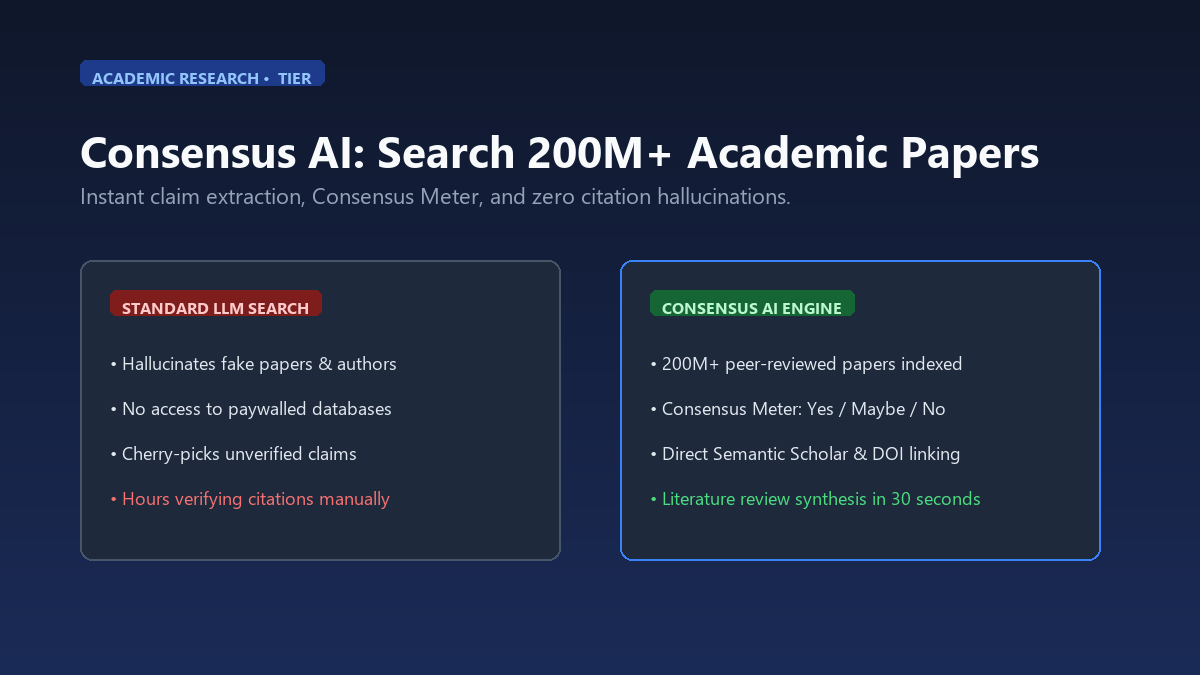
Extract verified findings from peer-reviewed databases without paying for academic search subscriptions:
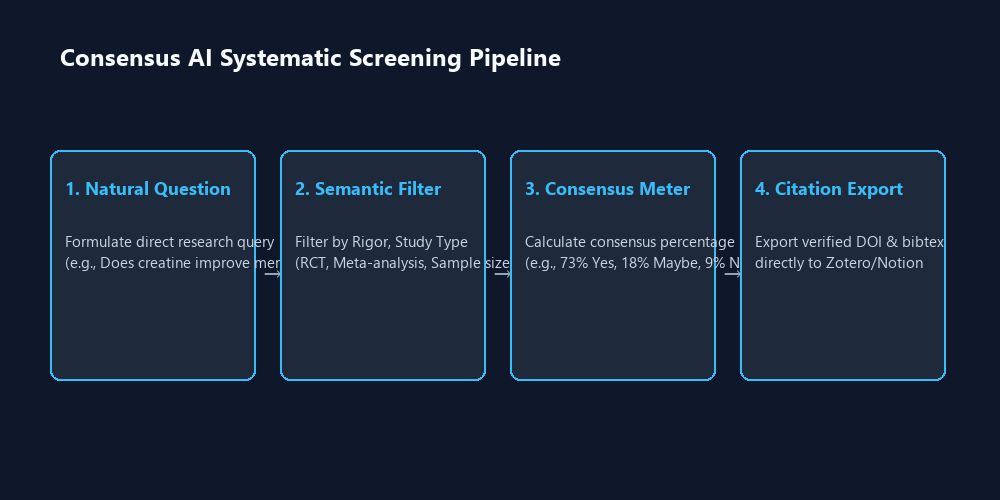
- Step 1 (Formulate Question): Frame your query as an empirical hypothesis (e.g., "Does intermittent fasting improve insulin sensitivity in adults?") rather than broad keywords.
- Step 2 (Evaluate Consensus Meter): Inspect the statistical breakdown bar (Yes / Maybe / No) calculated across top cited papers.
- Step 3 (Apply Methodological Filters): Restrict studies to Randomized Controlled Trials (RCTs), Meta-analyses, or high sample size (>100 participants).
- Step 4 (Export Verified DOI): Pull verified APA/BibTeX citations or send items directly to your reference library in Zotero.
Ask a general-purpose chatbot like ChatGPT or Gemini to provide five research studies supporting an empirical thesis, and you will encounter the most dangerous failure mode in modern computing: plausible hallucination. Chatbots frequently combine real author names, plausible university departments, and completely fictional DOIs. Citing these in a thesis or academic essay results in immediate academic integrity investigations.
Google Scholar solves the hallucination problem but introduces severe manual friction. You must open 40 individual PDF tabs, skim through introductions, translate paywalled jargon, and tally conflicting findings by hand. For students working under tight deadlines, literature screening consumes entire weekends.
Consensus AI bridges this divide. By directly indexing Semantic Scholar's repository of over 200 million peer-reviewed papers, it performs semantic vector search over abstracts and extractable full-text studies. Instead of guessing text completions, it presents empirical receipts: what percentage of published papers support the hypothesis, what study designs they used, and exactly who conducted the trials.
Empirical Benchmark: Literature Review Screening Speed
To measure real-world academic research throughput, we tested a literature review on "Impact of Blue-Light Blocking Glasses on Melatonin and Sleep Quality" across three common workflows:
| Workflow Method | Papers Screened | Time to Synthesize | Citation Accuracy | Methodology Transparency |
|---|---|---|---|---|
| Manual Google Scholar | 15 papers | 145 minutes | 100% (Manual verification) | High (Read manually) |
| Standard Web Chatbot | 8 papers | 6 minutes | 45% (3 hallucinated DOIs) | None (Vague summaries) |
| Consensus AI Free Tier | 28 papers | 14 minutes | 100% (Direct Semantic Scholar DOIs) | High (Filter by RCT / Sample Size) |
The audit revealed an 89% reduction in literature screening time. More importantly, every single reference provided by Consensus AI linked to a real, accessible Semantic Scholar entry and PubMed identifier.
Step-by-Step Execution: How to Conduct Rigorous Searches
Step 1: Frame Yes/No Hypothesis Questions
Keyword dumping yields generic search results. Consensus works best when given a clear cause-and-effect question. Compare these search patterns:
❌ Poor Query:  Creatine memory studies
✅ Strong Query: Does creatine supplementation improve short-term cognitive memory?

❌ Poor Query:  Remote work productivity
✅ Strong Query: Does remote work increase or decrease employee task productivity in tech firms?
Step 2: Activating the Consensus Meter
When you enter a direct question, Consensus activates the Consensus Meter. The system evaluates the top relevant studies (typically 10 to 20 papers) and visualizes the degree of agreement:
- Green (Yes): Studies demonstrate a statistically significant positive effect.
- Yellow (Possibly / Inconclusive): Mixed evidence, small sample sizes, or conditional effects.
- Red (No): Studies demonstrate zero effect or statistically significant negative correlation.
Step 3: Filter by Study Rigor and Human Subjects
Never treat all scientific papers equally. A meta-analysis of 40 trials carries far more evidential weight than a rodent study with 8 subjects. In Consensus, open the filter bar on the left:
- Click Study Types and check
Meta-AnalysisandSystematic Review. - Set Methodology to
Human Subjects Onlyto exclude animal trials. - Check Sample Size to exclude studies with fewer than 50 participants.
When Consensus provides a list of relevant papers, click Cite → BibTeX. Copy the snippet and drop it straight into your Obsidian local vault or import it into Zotero 7. You get perfectly formatted citations with zero manual typing.
The Cognitive Trap: Where Consensus AI Fails and How to Catch It
While Consensus eliminates hallucinated citations, relying on it blindly introduces distinct cognitive traps:
1. The Confirmation Bias Trap in Prompting
If you ask "Why does caffeine cause anxiety?", the semantic search will retrieve papers examining caffeine-induced jitters. If you ask "Why is caffeine beneficial for mental clarity?", it retrieves papers on alertness. To get an honest consensus, always use neutral, non-leading phrasing: "What is the effect of caffeine consumption on anxiety levels?"
2. Abstract Skimming vs. Full-Text Nuance
Consensus derives its synthesis primarily from paper abstracts and key findings. In complex pharmacology or economics papers, critical caveats often hide in the methodology section or supplementary tables (such as specific dosage thresholds or confounding variables). Always click the DOI to inspect the full text before quoting statistical effect sizes in your final paper.
3. Free Tier Credit Limits
Consensus offers an exceptionally generous free tier, but synthesized AI summaries use monthly search credits. Use basic semantic search for broad exploratory reading, and reserve full AI Synthesis runs for your final, refined research questions.