
When conducting a literature review for a thesis or research project, your biggest bottleneck is not finding papers—it is deciding which papers are actually worth a deep, two-hour reading session.
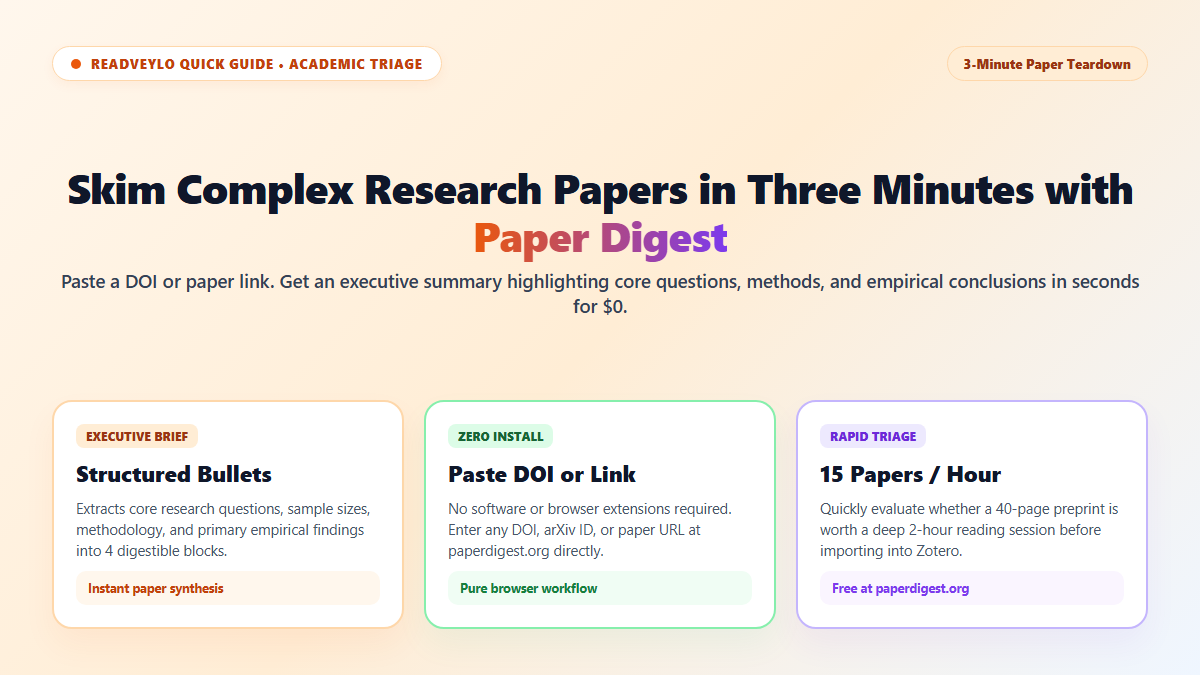
Standard paper abstracts are notoriously dense, jargon-filled, and frequently fail to disclose sample sizes or primary empirical findings. That is where Paper Digest (paperdigest.org) changes the game. It is a lightweight web portal that generates clean, 3-minute executive summaries of scholarly works directly in your browser.
What Is Paper Digest and What Can It Do for You?
Instead of forcing you to read introductory literature surveys and theoretical fluff, Paper Digest extracts the foundational intellectual backbone of a preprint into four structured questions:
- What is the Core Problem? The exact research question or theoretical tension the authors are attempting to resolve.
- What Method Was Applied? The experimental setup, clinical trial protocol, sample size, or dataset used.
- What Did the Study Discover? The primary empirical findings, effect sizes, and statistical outcomes without author hype.
- Why Does It Matter? The direct implications for subsequent literature and real-world implementation.
The 30-Second Browser Workflow to Screen Any Preprint
- Step 1: Copy Any DOI or Paper URL: Locate a research paper on arXiv, Nature, PubMed, or OpenAlex (see our guide on searching 250 million papers on OpenAlex). Copy its standard Digital Object Identifier (DOI) or URL.
- Step 2: Paste Into Paper Digest: Navigate to paperdigest.org in Chrome or Safari. Paste the DOI directly into the digest bar and click Digest.
- Step 3: Review the 3-Minute Teardown: In under 15 seconds, Paper Digest synthesizes the full text into a crisp bullet-point executive brief. You can immediately evaluate whether the paper merits full citation in Zotero or can be safely discarded.
Use Paper Digest for: Rapid triage. Screen 15 to 20 candidate studies per hour to decide which 3 papers belong in your dissertation outline.
Switch to Deep Tools for: Line-by-line verification. Once you select a foundational paper, switch to Humata AI for PDF interrogation or map citations visually with Litmaps.
By screening academic literature through Paper Digest before diving into dense PDFs, you eliminate 80% of wasted reading time. You protect your attention for the high-impact papers that truly matter.
If you need to interrogate full documents and get instant page citations in under 60 seconds, check out our guide on extracting instant answers with ChatPDF.