
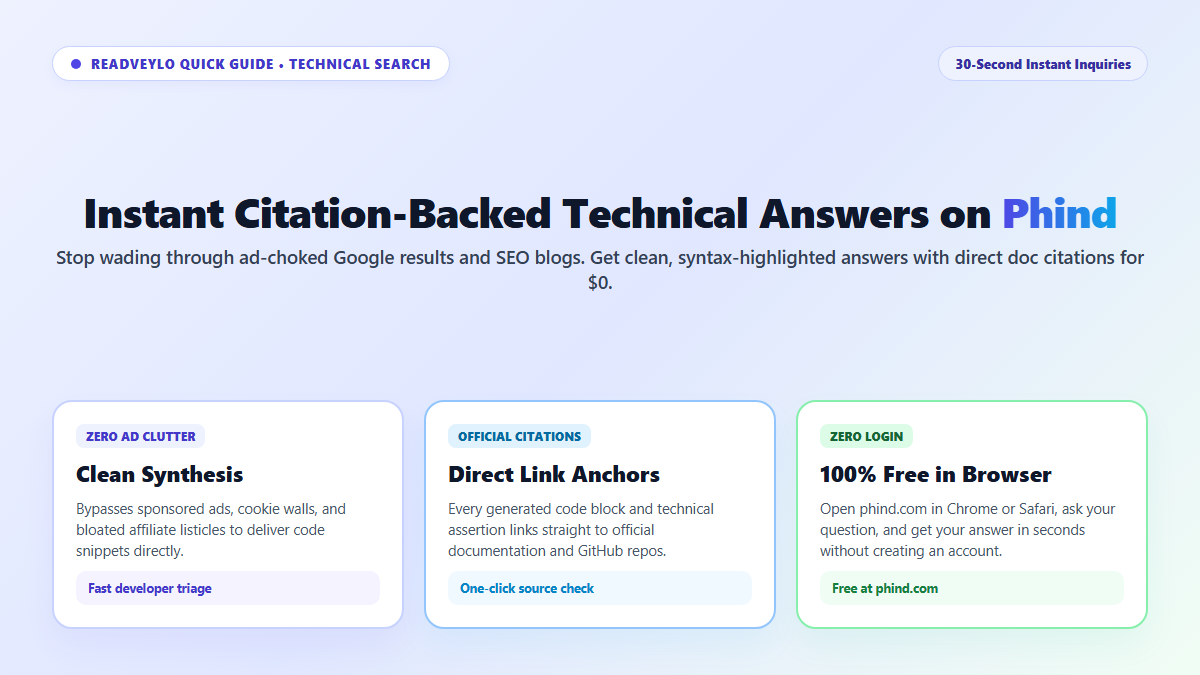
Whenever you search for a specific configuration flag, statistical formula, or API parameter on standard search engines, you have to wade through three sponsored ad slots, accept two GDPR cookie banners, and scan past 800 words of SEO fluff before finding the actual two-line syntax you need.
That search friction wastes hours of engineering and research time. I stopped using standard search for technical inquiries the moment I switched to Phind (phind.com). It is an intelligent search engine designed from scratch for technical students, developers, and researchers.
What Is Phind and What Can It Do for You?
Phind behaves like a specialized researcher sitting between you and the live internet. Instead of returning a list of blue links, it searches official documentation, GitHub repositories, and technical papers in real time, synthesizes an exact answer, and displays the direct citations in the right-hand margin.
- Zero Ad Pollution: No sponsored links, no affiliate banners, and no AI marketing noise. You get a clean markdown answer with code blocks formatted for immediate use.
- Verifiable Source Citations: Every line of reasoning links to an authoritative URL—whether that is the official Python documentation, MDN Web Docs, or a verified Stack Overflow thread.
- Zero Sign-Up Required: You do not need to enter an email, connect a credit card, or join a waitlist. Open the browser and type immediately.
The 3-Step Zero-Install Workflow to Get Answers in 30 Seconds
- Step 1: Open Phind in Any Browser: Navigate to phind.com in Chrome, Safari, or Edge. You are immediately presented with an uncluttered query bar.
- Step 2: Ask Your Specific Technical Question: Avoid generic keyword queries. Frame your question naturally with your tech stack:
"How do I set up a custom CSS dark-mode toggle without flashing in vanilla JS?"or"What is the mathematical difference between FSRS and SM-2 in spaced repetition?" - Step 3: Review Answer & Verify Citations: The answer generates in under 5 seconds with complete code blocks. Click the numbered badge next to any claim to open the exact official documentation page to verify the solution.
Where It Shines: Solving specific coding bugs, parsing tricky CLI parameters, comparing framework architectures, and explaining statistical algorithms without ad clutter.
Where It Falls Short: Highly speculative creative writing or broad conversational banter. For long-form narrative drafts, see our breakdown of Perplexity vs ChatGPT or our guide to Mistral Le Chat. For technical problem solving, Phind wins every time.
If you want to accelerate your research without getting distracted by ad farms, bookmark Phind in your browser toolbar. You can also pair your technical search with our guide on mapping research literature in Obsidian Canvas or skimming preprints with Paper Digest. It turns 15-minute search rabbit holes into 30-second verified solutions.