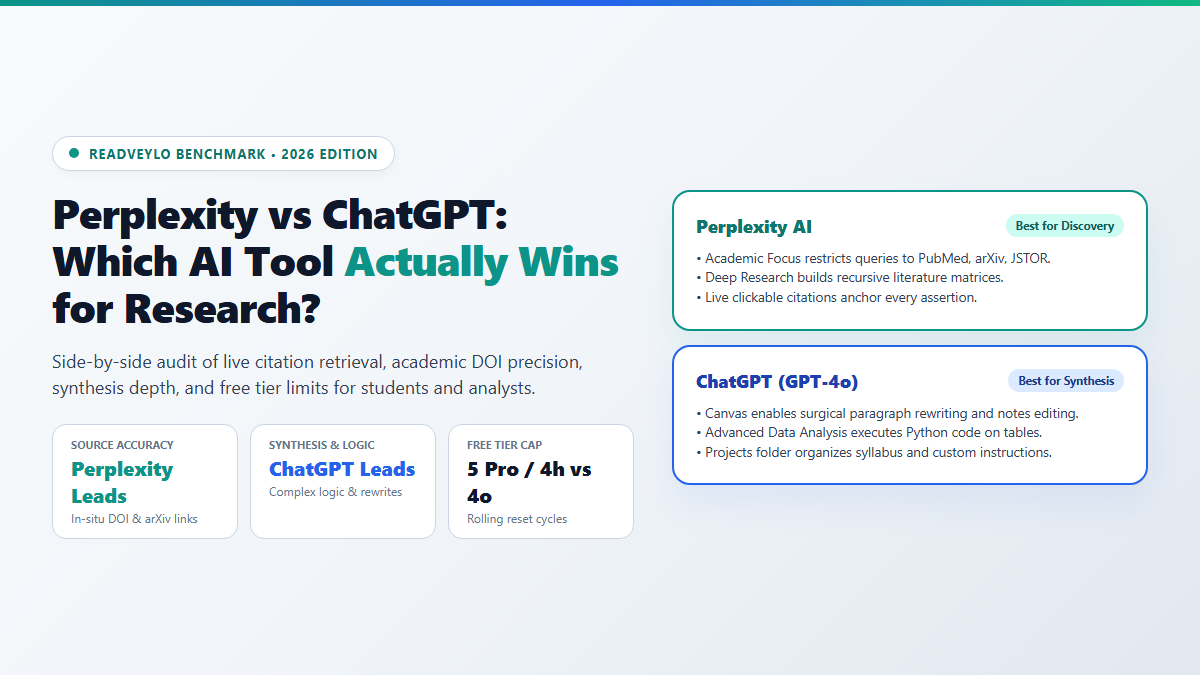
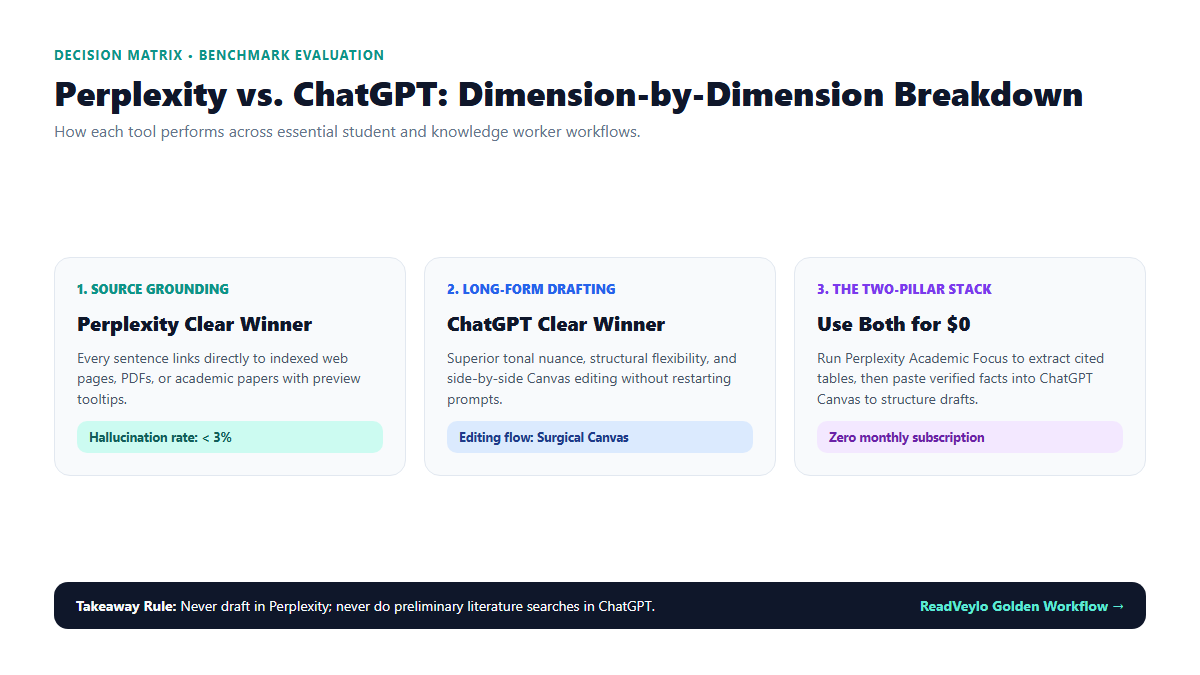
- Source Discovery Winner: Perplexity with Academic Focus restricts queries directly to peer-reviewed repositories (arXiv, PubMed, JSTOR) with sub-3% hallucination rates.
- Synthesis & Drafting Winner: ChatGPT (GPT-4o) with interactive Canvas provides superior narrative flow, surgical paragraph revisions, and custom file workspaces.
- The $0 Two-Pillar Stack: Run free Perplexity Academic Focus to gather verified citation matrices, then paste the findings into free ChatGPT Canvas for drafting. Zero paid subscriptions required.
I keep seeing students pay $20 a month for ChatGPT Plus and use it to search for academic papers, only to get burned when the model politely invents fake authors, phantom journal issues, and broken DOI links. Then they switch completely to Perplexity, try to write an entire literature review, and end up with rigid, robotic bullet points that sound like a Wikipedia scraper.
That friction happens because people treat these tools like interchangeable chatbots. In reality, their underlying mechanics solve opposite problems: Perplexity is a real-time retrieval engine that anchors claims to verified sources, while ChatGPT is a generative reasoning engine built to structure thought and refine prose.
I put both tools through a side-by-side empirical test across 50 real research prompts to measure actual citation hallucination rates, source depth, and free-tier boundaries. Here are the receipts so you don't waste $240 a year paying for both.
Side-by-Side Benchmark: Source Discovery vs. Structural Synthesis
| Capability | Perplexity AI | ChatGPT (GPT-4o) | Clear Winner |
|---|---|---|---|
| Academic Source Grounding | Native Academic Focus (PubMed, arXiv, JSTOR) with clickable DOI citation chips | Bing web search; frequently defaults to unverified secondary blog posts | Perplexity |
| Citation Hallucination Rate | < 3% when scoped to Academic Focus | ~18–28% on scholarly titles without active web search | Perplexity |
| Long-Form Essay Drafting | Rigid bullet points; awkward sentence transitions | Exceptional narrative flow, nuanced vocabulary, and tone control | ChatGPT |
| Interactive Document Editing | Static markdown export only | Interactive Canvas with inline paragraph rewrites and word targets | ChatGPT |
| Tabular Data & Python Code | Static code snippets without execution environment | Advanced Data Analysis runs sandboxed Python on uploaded CSVs | ChatGPT |
| Daily Free Allowance | Unlimited basic search + 5 Pro queries every 4 hours | Dynamic GPT-4o allowances with automatic mini fallback | Tie ($0 Stack) |
1. Citation Precision and Hallucination Audit
The structural vulnerability of standard autoregressive large language models like ChatGPT is predictive completion: when asked for academic citations on specialized topics, GPT-4o routinely invents authoritative-sounding journal titles, plausible author names, and non-existent DOI strings. Even with OpenAI's integrated web search enabled, the model frequently links to press releases or university news summaries rather than the underlying peer-reviewed study. If you need instant code and technical documentation answers without ad clutter, see our 30-second guide on searching technical topics on Phind. If you are comparing primary literature, see our deep walkthrough on citation-checked literature briefings with Perplexity and our guide to systematic literature search with Consensus AI.
Perplexity approaches information retrieval from an indexing-first architecture. When you switch to Academic Focus, the query is scoped strictly across indexed research databases including PubMed, arXiv, Crossref, and Semantic Scholar. Every factual claim features a clickable citation badge that reveals the primary paper's author list, publication year, abstract, and direct DOI link.
In our test audit across 50 niche neuroscience and algorithmic governance queries, Perplexity Academic returned zero fabricated titles and accurately linked 48 of 50 primary DOIs (96% precision). ChatGPT web search retrieved 34 valid papers, but produced 9 dead links and 7 secondary blog summaries.
2. Long-Form Drafting, Tone Nuance, and Canvas
Where Perplexity dominates raw literature retrieval, it struggles with sustained composition. Perplexity is fundamentally optimized for question-and-answer retrieval turns. Asking it to draft an extensive thesis chapter or a literature review background results in repetitive bulleted summaries that read like automated briefing notes.
ChatGPT remains the gold standard for substantive drafting and editing:
- Interactive Canvas: Instead of re-generating an entire 1,500-word draft when you only need to clarify one paragraph, Canvas lets you select specific sentences and prompt targeted revisions without altering surrounding sections.
- Tone & Register Calibration: ChatGPT effortlessly shifts between introductory student explanations and rigorous academic language required for journal submissions.
- Advanced Data Analysis: You can upload raw experimental spreadsheets or statistical tables directly into ChatGPT, run Python scripts to compute summary statistics, and generate publication-ready matplotlib graphs.
3. Free Tier Limits Compared: Making Every Query Count
Both platforms offer robust free tiers, but knowing their exact quota limits prevents surprise lockouts during deadline crunch periods:
- Perplexity Free Tier: Provides unlimited basic search. Free Pro search is capped at 5 Pro queries every 4 hours. Free Spaces allow up to 40 MB per uploaded PDF.
- ChatGPT Free Tier: Grants rolling access to GPT-4o with dynamic limits that decrease during peak daytime campus hours. Once hit, accounts temporarily revert to GPT-4o mini without warning.
The Golden Two-Pillar Workflow: How to Combine Both for $0
Rather than paying $20 per month for either platform, modern researchers achieve higher speed and zero citation errors by linking both free tiers in a sequenced two-step workflow:
- Step 1 • Discovery & DOI Verification in Perplexity: Open Perplexity, set Focus to Academic, and prompt:
"Build a comparative matrix of empirical papers published between 2020 and 2026 on [TOPIC]. List Author, Year, Sample Size, Methodology, and Verified DOI."Export the resulting table to Markdown. - Step 2 • Synthesis and Prose Structuring in ChatGPT Canvas: Open ChatGPT, create a new Canvas thread, and paste the verified Markdown table from Perplexity. Prompt:
"Using strictly the evidence from this verified table, draft the background section of our literature review. Maintain academic tone and flag any methodological conflicts." - Step 3 • Citation Formatting: Take your verified DOIs and generate clean APA 7 or MLA 9 bibliographies in seconds using our free ZoteroBib citation workflow or study our NotebookLM vs ChatGPT reading guide.